
Back to blog
History9 min read

Who Is Krampus? The Christmas Devil Explained

Who is Krampus? Meet the horned Christmas devil of Alpine folklore: what he does on Krampusnacht, where he really comes from, and how he relates to Santa.

SnackIQ

By SnackIQ Team

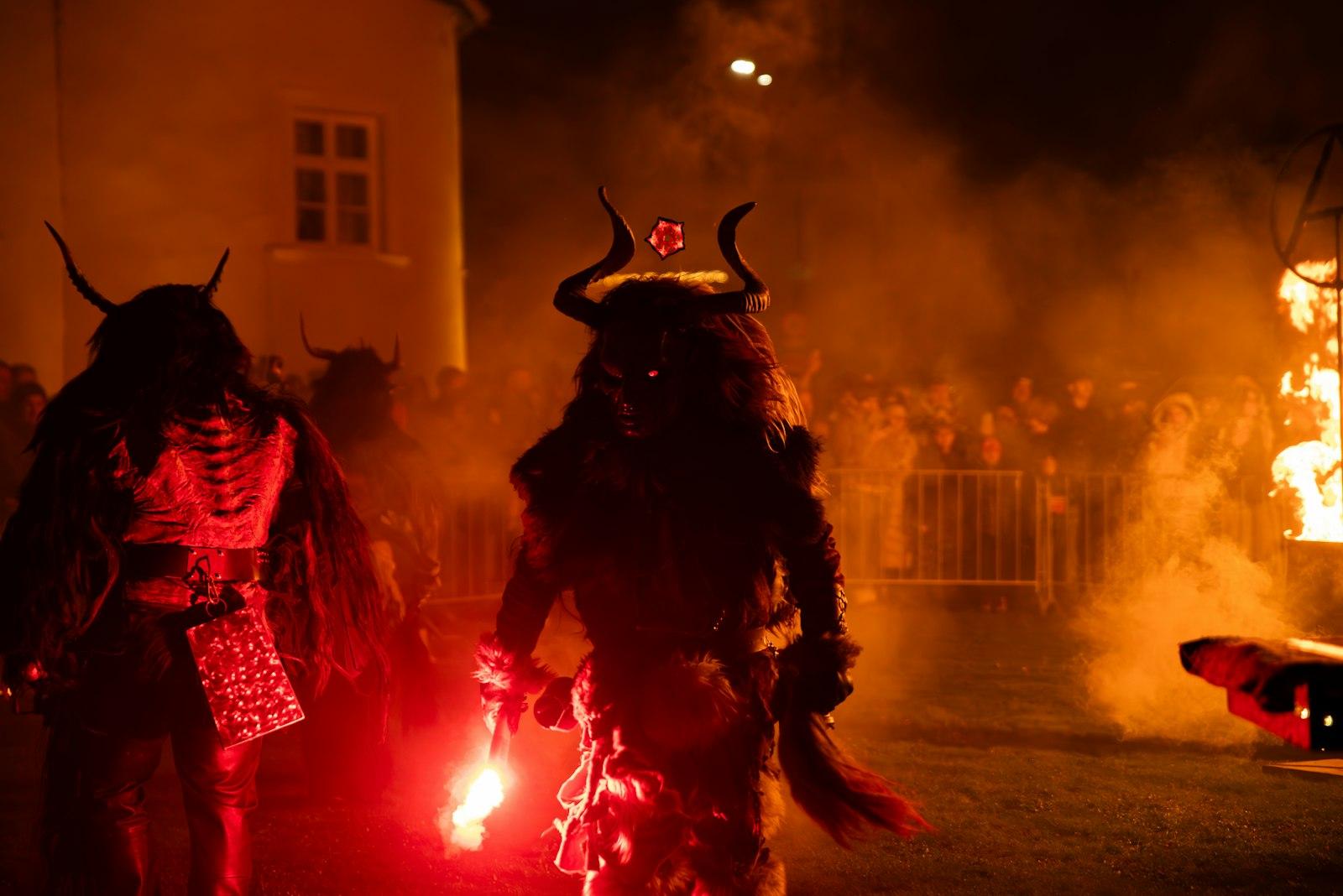
People in Krampus costumes with torches at night

On the night of December 5, in towns across Austria and southern Germany, something strange happens. Groups of figures in carved wooden masks, shaggy fur and huge curling horns come charging down the street, ringing bells, rattling chains and swatting at anyone who gets too close. This is Krampus, the Christmas devil, and in the Alps he's been part of the season for centuries.

Krampus is having a moment far beyond the Alps, too. There are Krampus parades in American cities, Krampus horror films and Krampus sweaters. But most of what gets repeated about him online, that he's an ancient pagan god or the son of a Norse goddess of death, doesn't hold up.

Here's who Krampus really is: what he does on Krampusnacht, where he comes from, why he looks like a goat, why he was once banned, and how he's connected to Santa Claus. There's a quick quiz at the end.

Who Is Krampus?

Krampus is a horned, half-goat, half-demon figure from the folklore of the Alps. He's the dark partner of Saint Nicholas. While the saint rewards children who have been good, Krampus deals with the ones who haven't, threatening them with a bundle of birch switches. In the scarier versions of the story, he stuffs naughty children into a sack or basket and carries them off.

He usually has long horns, a shaggy coat of fur, hooves, claws and a long red tongue, and he often carries chains and bells. In many places Krampus isn't one monster but a type of monster, a bit like a werewolf, so you can meet a whole crowd of Krampuses at once.

Nobody is sure where his name comes from. The two main theories, according to the Library of Congress, are the Old High German word Krampe, meaning a hook or claw, and the Bavarian dialect word Krampn, meaning dried out, shriveled or dead. Neither makes him sound friendly.

What Is Krampusnacht?

Krampusnacht, or Krampus Night, is December 5, the night before the Feast of Saint Nicholas on December 6. Traditionally, Saint Nicholas visits homes that evening with Krampus at his side. The saint asks whether the children have behaved and hands out treats, while Krampus rattles his chains in the background as a reminder of what happens if they haven't.

In much of Austria and southern Germany, adults dressed as Krampus still visit homes on the night to frighten children, all in good fun. The treats come too: a 19th-century account quoted by the Library of Congress describes Austrian sweet shops attaching a little red devil, called a krampus, to every box of sugar plums for children.

Krampus belongs to the start of December, not to Christmas Eve. By the time Christmas arrives, his work is done.

Santa kept the presents and dropped the punishment. Krampus got the job nobody else wanted.

Where Does Krampus Come From?

Krampus comes mainly from the German-speaking Alps, especially Austria, around Styria and Salzburg, and Bavaria in southern Germany. He also appears in neighboring areas where cultures meet, including Slovenia, Croatia, Hungary, the Czech Republic, Slovakia and northern Italy, including South Tyrol.

The oldest firm evidence is younger than most people assume. A scholarly study of the Krampus runs in Salzburg found no written evidence of the custom before 1582. By the 1600s and 1700s, records show the archbishops of Salzburg trying to stamp it out, without much success.

So Krampus has a long history, around 400 years of it on paper, but not the thousands of years you'll often see claimed.

Is Krampus Really an Ancient Pagan God?

This is the most repeated claim about Krampus, and the weakest. You'll often read that he's a pre-Christian god, or the son of Hel, the Norse goddess of the dead. There's no old source for either idea. Historians generally consider a pagan origin unlikely, because Krampus doesn't appear in any record until the 1500s, and the Library of Congress's folklorists describe the "son of Hel" story as resting on very shaky ground.

What's more likely is that Krampus is a Christian devil who borrowed from older traditions around him. In the Alps, masked winter figures called Perchten roamed villages in fur and frightening masks, and they had a big influence on how Krampus looks and behaves. Medieval devils in general also borrowed features from older gods and monsters.

So the honest answer is that Krampus is a devil from Christian folk tradition, with some distant pagan echoes, rather than a pagan god in disguise.

Why Does Krampus Look Like a Goat?

Krampus looks like a goat because he's a devil. For centuries, Christian art drew the devil with goat-like horns, shaggy legs and hooves, and Krampus grew out of that tradition. His horns, fur and hooves are the standard signs of a devil, not a separate goat myth.

The rest of his look comes from the people who play him. Krampus masks in Austria are traditionally carved from wood by hand, and the costumes are made from sheep or goat skin, with large cowbells hung around the waist. That's why a Krampus run is so loud: the bells and chains are part of the show, warning everyone that the devils are coming.

What Is a Krampus Run?

A Krampuslauf, or Krampus run, is a parade of people dressed as Krampus. Groups of performers, traditionally young men, charge through the streets in masks and fur, ringing bells, roaring at the crowd and swatting onlookers with switches. It's loud, smoky and a little chaotic, which is exactly the point.

Krampus runs are held across Austria and Bavaria in late November and early December. Munich and the Austrian Alps host some of the best known, and many smaller towns have their own. The tradition has spread abroad too: the Library of Congress notes Krampus events across the United States.

If you go, stand back from the front row. Chasing the crowd is part of the tradition, and the switches are real.

Was Krampus Ever Banned?

Yes, more than once. In the 1600s and 1700s, the archbishops of Salzburg tried to stop people dressing up as devils, with little success. In the 1930s, Austria's authoritarian government under Engelbert Dollfuss banned the Krampus tradition outright.

Krampus survived both, partly through the post. In the 1800s, Krampus greeting cards, called Krampuskarten, became hugely popular, often printed with the words "Gruß vom Krampus", or "Greetings from Krampus". They weren't always scary. Some showed Krampus as a young woman hunting for men, or as a puppeteer pulling the strings of a courting couple. Today those old cards are collectors' items.

Is Krampus Related to Santa?

Not directly, and he isn't Santa's brother, despite what you may have heard. Krampus is the partner of Saint Nicholas, the fourth-century bishop whose legend later grew into Santa Claus. So the closest thing to a relationship is that Krampus worked with Santa's ancestor.

He isn't the only dark helper either. Across Europe, Saint Nicholas has traveled with a whole cast of companions who keep children in line. In much of Germany it's Knecht Ruprecht, and in Alsace it's Hans Trapp. In the Palatinate region of Germany there's Belsnickel, a grumpy, fur-clad figure whose name means roughly "fur Nicholas". German immigrants took him to Pennsylvania, where he was well known by the early 1800s, visiting homes before Christmas to check on children's behavior. Fans of the American version of The Office may know him from Dwight's Christmas party.

Santa kept the presents and dropped the punishment, and the scary job fell to these companions instead.

How Did Krampus Become Famous in America?

For a long time, few Americans had heard of Krampus outside German-speaking communities. That has changed in recent years, as old Krampuskarten spread online and American cities started holding their own Krampus parades and parties.

Hollywood finished the job. Krampus, a Christmas horror comedy directed by Michael Dougherty and starring Adam Scott and Toni Collette, came out in December 2015 and turned him into a pop-culture monster. More recently he turned up in the big-budget Christmas action film Red One.

Each new film and parade brings a fresh wave of people asking the same question you probably typed in: who is Krampus? Now you know.

How Well Do You Know Krampus?

Six quick questions to test what you just read, or to try on friends. Tap Reveal answer to check each one.

  1. On which night does Krampus traditionally appear?
    Reveal answer

    December 5, Krampusnacht, the night before Saint Nicholas Day.

  2. Whose partner is Krampus?
    Reveal answer

    Saint Nicholas, who rewards the good children while Krampus deals with the naughty ones.

  3. What does Krampus carry to punish children?
    Reveal answer

    A bundle of birch switches, and sometimes a sack or basket to carry them off.

  4. What is a Krampuslauf?
    Reveal answer

    A Krampus run: a parade of people in Krampus costumes charging through the streets.

  5. What were Krampuskarten?
    Reveal answer

    Krampus greeting cards, popular in the 1800s, often saying "Greetings from Krampus".

  6. Which German figure did immigrants bring to Pennsylvania?
    Reveal answer

    Belsnickel, a fur-clad figure who checks on children before Christmas.

Got all six? You know more about Krampus than most of the people dressed as him.

Krampus is a horned Christmas devil from the Alps who partners Saint Nicholas, punishes naughty children on the night of December 5, and has survived archbishops, a 1930s ban and the march of Santa Claus. He isn't an ancient pagan god, and he isn't Santa's brother, but he is one of the oldest and strangest Christmas characters still around.

That's what makes him fun. Behind the horns and chains is a real piece of history: a reminder that, for centuries, the Christmas season came with a warning as well as a reward.

If you like finding out where traditions really come from, a minute at a time, that's what we're building SnackIQ for. It's opening soon, and you can join the waitlist now.

Related terms

Plain-English definitions from the SnackIQ Glossary.

  • Amygdala

    /əˈmɪɡdələ/Neuroscience

    The amygdala is an almond-shaped structure deep in the brain that processes emotions, particularly fear and threat, and triggers the body's rapid stress response before the rational brain has time to react.

  • Appeal to Tradition

    /əˈpiːl tə trəˈdɪʃən/Critical Thinking

    Appeal to tradition is a logical fallacy that argues something is true, good, or correct simply because it has been done that way for a long time.

Frequently asked questions

  • Krampus isn't a real creature. He's a character from Alpine folklore, the devilish partner of Saint Nicholas who punishes naughty children. But the tradition is very real: every December, people in Austria, southern Germany and beyond dress up as Krampus in carved masks and fur for Krampusnacht visits and Krampus runs through the streets.

  • Krampus comes mainly from Austria, especially Styria and Salzburg, and from Bavaria in southern Germany. He also appears in neighboring areas, including Slovenia, Croatia, Hungary, the Czech Republic, Slovakia and northern Italy. The oldest firm record of the custom is from Salzburg in 1582.

  • Krampusnacht, or Krampus Night, is December 5, the night before the Feast of Saint Nicholas on December 6. Traditionally, Saint Nicholas visits homes that night with Krampus beside him. Krampus runs, where costumed performers parade through the streets, are held across late November and early December.

  • No. Krampus has no family tie to Santa Claus. He's the companion of Saint Nicholas, the fourth-century bishop whose legend later became Santa, so he worked alongside Santa's ancestor rather than being related to him. Other companions of Saint Nicholas include Knecht Ruprecht in Germany and Belsnickel in the Palatinate.

Share article

SnackIQ

Written by

SnackIQ Team

SnackIQ is a daily learning app with short, fun lessons that fit into a spare few minutes. We're the team building it. Here we share news about the app and plain-English articles on the ideas behind our lessons.

About SnackIQ