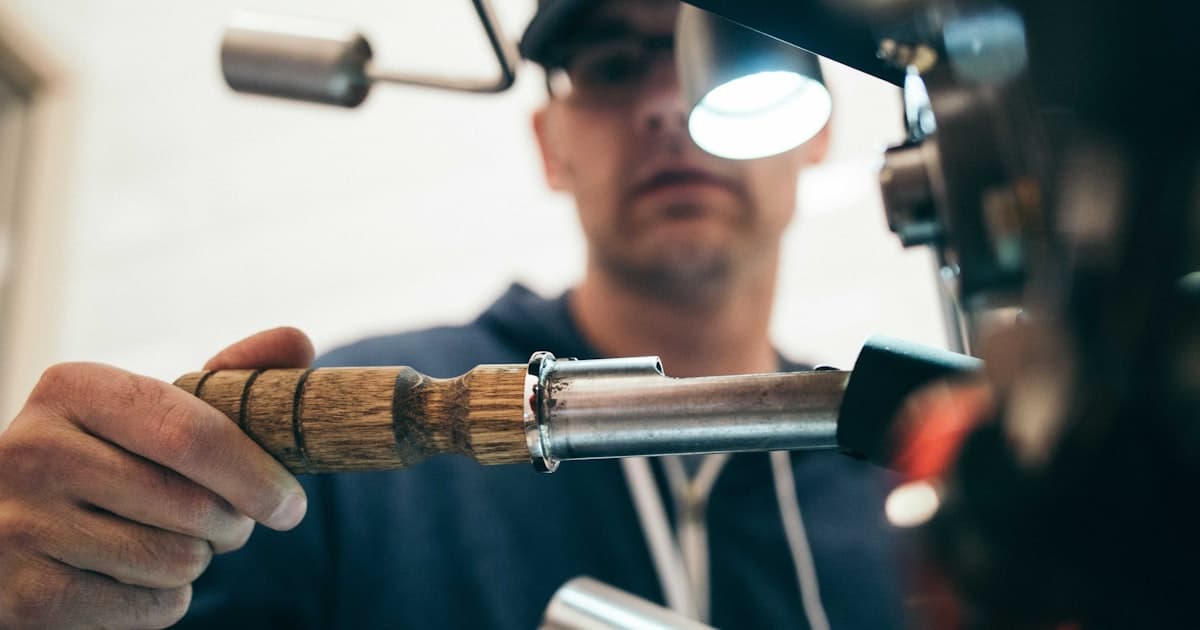
You don't need a physics degree to understand quantum mechanics — you just need a coffee cup. The same laws that govern the behaviour of electrons and photons are quietly at work every time you brew your morning cup.
Why hot things glow
When you heat water in a kettle, the molecules vibrate faster and faster. Quantum mechanics explains why the energy in those vibrations can only come in discrete packets — called quanta — rather than a smooth, continuous flow. Max Planck discovered this in 1900 trying to explain why hot objects emit light the way they do. He expected a smooth curve. He got something that only made sense if energy was chunky. This discovery — that energy is quantised — is the founding moment of quantum mechanics, and it happened because Planck was trying to explain why your kettle glows red before it glows orange, never the other way around.
The coffee molecule
Caffeine's effect on your brain is a quantum story too. The molecule binds to adenosine receptors through a process governed by electron orbital shapes — the same electron clouds described by Schrödinger's wave equation. Change the quantum structure of the caffeine molecule even slightly, and it no longer fits the receptor. No fit, no alertness. This precise molecular docking is why decaffeinated coffee is made by removing caffeine rather than replacing it with something else — there is no close substitute that fits the same receptor without the quantum geometry being exactly right. Every psychoactive drug, from caffeine to anaesthetics, works through this same principle of quantum-level molecular fit.
Tunnelling through your mug
Quantum tunnelling — the phenomenon where particles pass through barriers they classically shouldn't be able to cross — is happening in the chemical reactions inside your coffee right now. Enzymes in your digestive system use tunnelling to speed up reactions that would otherwise take far too long. Without quantum weirdness, digesting your breakfast would take centuries. This isn't metaphorical: a 2013 study published in the Journal of Physical Chemistry demonstrated that enzyme-catalysed hydrogen transfer reactions — the kind that happen when you digest food — proceed 1,000 times faster than classical physics predicts, exactly as quantum tunnelling models forecast.
The quantum roast
The Maillard reaction — the browning process that creates the hundreds of flavour compounds in roasted coffee — is fundamentally a quantum chemistry process. Electrons in the sugar and amino acid molecules form new bonds according to quantum probability distributions, not classical mechanics. The specific temperature profile of the roast determines which quantum pathways are favoured, which is why the difference between a light roast and a dark roast is, at its deepest level, a difference in quantum chemistry. Professional roasters are, without knowing it, quantum chemists — they are optimising the quantum interactions of molecules to produce a specific sensory outcome.
What this means for how you see everyday life
The practical implication of all this isn't that you need a physics degree to enjoy coffee. It's that the apparently simple and familiar is, at every level, extraordinary. Quantum mechanics isn't a phenomenon that only occurs in particle accelerators and physics laboratories. It's the foundation of chemistry, which is the foundation of biology, which is the foundation of every experience you've ever had. The steam rising from your cup follows laws that Einstein spent decades wrestling with. The alertness you feel after the first sip involves molecular interactions that won the Nobel Prize when they were first explained. Recognising this doesn't make the coffee taste different — but it does change what you are when you drink it.
“Every sip of coffee is a celebration of quantum mechanics — you just never knew you were raising a toast to Planck.”
Pro tip
Next time someone says quantum physics is too abstract, remind them: the reason coffee tastes different from tea is, at its root, a quantum chemistry question.
Physics isn't something that happens in particle accelerators far away from your daily life. It's the reason your coffee is hot, the reason the caffeine works, and the reason you're awake to read this.
Share this snack