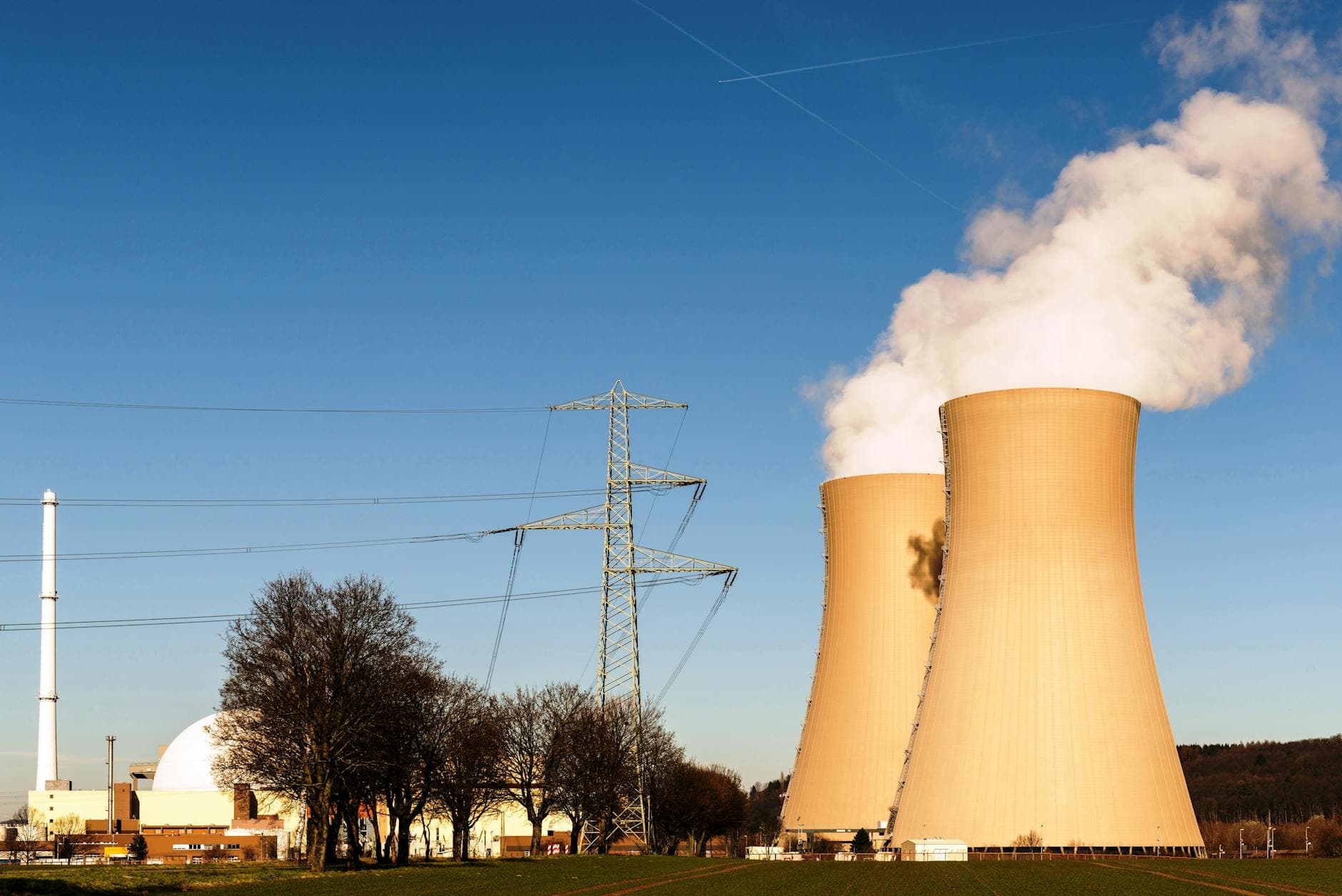
How AI uses water is one of the least-discussed environmental questions of the decade — and one of the most urgent. Every time you ask a chatbot a question, generate an image, or use an AI-powered search engine, a data centre somewhere is consuming water to keep its servers from overheating. Microsoft reported that its global water consumption grew by more than 34% between 2021 and 2022, a period that coincided directly with the rapid scaling of its AI infrastructure. The water doesn't vanish. It evaporates into the atmosphere or gets discharged as heated wastewater. Either way, it's gone from wherever it was taken. Understanding why AI is so thirsty — and how thirsty it actually is — changes how you think about the cost of convenience.
Why Servers Run So Hot
A server rack is essentially a wall of processors running at full capacity, around the clock, every day of the year. Unlike your laptop, which gets warm during a video call and then cools down, data centre hardware never really rests. The computational intensity of AI workloads — particularly training large models — pushes chips to sustained loads that generate enormous heat.
Graphics processing units, or GPUs, are the workhorses of modern AI. They were originally designed for rendering video game graphics, but their ability to handle thousands of parallel calculations made them ideal for training neural networks. The trade-off is power consumption. A single high-end GPU can draw 300 to 700 watts of power. A large AI training cluster might contain tens of thousands of them, running simultaneously for weeks or months.
All that electrical energy eventually becomes heat. Physics doesn't negotiate. And heat is the enemy of silicon — sustained high temperatures degrade hardware, reduce performance, and shorten the lifespan of expensive equipment. Keeping servers within their safe operating temperature range isn't optional. It's the entire engineering challenge that data centres are built around.
The solution, for most large-scale facilities, involves some form of cooling that uses water. Not because engineers are indifferent to the environmental cost, but because water is extraordinarily effective at absorbing and transferring heat. Kilogram for kilogram, it holds more thermal energy than almost any other common substance. That physical property is why water became the default coolant for industrial processes long before AI existed — and why it remains central to the infrastructure powering it today.
What Actually Happens to the Water
Data centres consume water in two distinct ways, and it's worth separating them because they have different environmental implications.
The first is direct use, where water circulates through cooling towers or chillers that lower the temperature of the air or equipment inside the facility. In evaporative cooling systems — the most common large-scale approach — warm water is exposed to air, and a portion evaporates, carrying heat away with it. That evaporated water is genuinely consumed: it leaves the local water supply and enters the atmosphere as vapour. The remaining, now-cooler water recirculates through the system. Depending on the climate and the facility design, a significant fraction of the water drawn in is lost this way.
The second is indirect use, associated with generating the electricity that powers the servers in the first place. Thermal power plants — coal, gas, and nuclear — use enormous volumes of water for steam generation and cooling. Researchers at the University of California, Riverside have studied this indirect water footprint and found it can rival or exceed the direct consumption of the data centre itself, depending on the local energy mix.
The geography of data centres matters enormously here. A facility in Iceland, running on geothermal energy and using cold outside air for cooling, has a dramatically lower water footprint than an identical facility in Arizona drawing on coal-powered electricity and relying on evaporative cooling in a hot, dry climate. Google, Microsoft, and Amazon have all disclosed water usage effectiveness metrics in recent years, partly because regulators and investors have started asking — but the figures vary widely between regions and facilities.
Training a Model vs. Answering a Question
Not all AI activity is equally water-intensive. There's a meaningful distinction between training a model and running it — and the difference in scale is enormous.
Training is the process of building an AI model from scratch, feeding it vast quantities of data and adjusting billions of internal parameters until its outputs improve. For frontier models like GPT-4 or Google's Gemini, this process runs for weeks or months on clusters containing thousands of specialised chips. Researchers at the University of Massachusetts Amherst have studied the carbon and energy costs of training large language models, finding them comparable to the lifecycle emissions of multiple cars. The water consumption during training follows a similar logic: sustained, heavy computational load means sustained, heavy cooling demand.
Inference — the process of actually using a trained model to respond to a query — is less intensive per individual request. A single question to a chatbot demands relatively modest computation. But scale changes everything. When millions of people use AI tools simultaneously, the aggregate inference load across a data centre becomes enormous, and cooling requirements scale accordingly.
Researchers at UC Riverside estimated in a widely-cited 2023 study that a conversation of roughly 20 to 50 questions with a large language model could consume roughly half a litre of water, depending on where and how the model is hosted. That figure surprised many people. A short back-and-forth with a chatbot, comparable in water cost to a small glass of drinking water.
For context, the global volume of AI queries is measured in billions per day. Even conservative estimates suggest the aggregate water footprint of AI inference is already substantial — and growing faster than the infrastructure designed to reduce it.
The Places Bearing the Real Cost
Data centres don't distribute their environmental burden evenly across the planet. They concentrate it in specific places — often places that didn't necessarily choose to host them.
The American Southwest is a striking example. Arizona and Nevada have attracted major data centre investment because of cheap land, business-friendly regulations, and reliable power. But both states sit in some of the most water-stressed regions on Earth. The Colorado River, which supplies water to roughly 40 million people across seven US states and parts of Mexico, has been running at critically low levels for years. Building water-intensive infrastructure in this landscape creates a direct tension between economic development and resource sustainability.
Ireland hosts a disproportionate share of European data centre capacity — partly due to tax policy, partly due to its position as a transatlantic connectivity hub. The country's grid operator, EirGrid, has warned that data centre electricity demand could account for a third of Ireland's total national consumption by the end of this decade. Water stress is less acute in Ireland's wet climate, but the electricity pressure creates its own resource problem.
In Chile, local communities have pushed back against data centre development in the Atacama region, one of the driest places on Earth. The tension between global tech infrastructure and local water rights is becoming a recurring flashpoint across multiple continents.
None of this means AI is inherently incompatible with environmental sustainability. But the current buildout is happening faster than the policy frameworks and engineering solutions designed to manage its impact. The communities closest to large data centres often bear the most immediate costs while receiving the least direct benefit from the AI services those facilities power.
What the Industry Is Actually Doing About It
The good news is that cooling technology has advanced significantly, and the major hyperscale operators are investing heavily in reducing water consumption — partly for environmental reasons, partly because water costs money and regulatory pressure is rising.
Direct liquid cooling is the most promising alternative to evaporative systems. Instead of cooling the air around servers, liquid is circulated directly to the chips, absorbing heat at the source. This approach is dramatically more efficient and can operate in closed-loop systems that consume little or no water. Companies including Intel and NVIDIA have designed chips with direct liquid cooling in mind, and newer data centre builds are increasingly incorporating it. The challenge is cost and retrofitting: replacing cooling infrastructure in an existing facility is expensive and complex.
AI is also being deployed to optimise the very cooling systems that AI requires. Google has used reinforcement learning algorithms — a branch of machine learning where a system learns through trial and error — to manage cooling in its data centres. The company reported that this approach reduced cooling energy consumption by roughly 40% in pilot facilities. DeepMind, Google's AI research lab, has published details on this work, making it one of the clearer examples of AI reducing its own environmental footprint.
There's also a growing push toward siting data centres in climates where ambient air temperature and humidity allow for free cooling — where outside air, properly filtered, can cool servers without any refrigeration or water evaporation. Nordic countries, Canada, and parts of the UK are increasingly attractive for this reason.
The honest assessment is that efficiency improvements are real but incremental, while the growth in AI demand is exponential. Engineers are getting better at cooling data centres. But more data centres are being built faster than efficiency gains can offset the total resource consumption. The net trajectory, for now, is still upward.
“A 20-question AI chat session may consume roughly half a litre of water.”
Pro tip
When choosing AI tools for regular use, look up whether the provider publishes a Water Usage Effectiveness (WUE) score — a metric standardised by the Green Grid consortium. Providers that publish this figure are at least measuring and managing their water consumption. Those that don't are probably not prioritising it. Lower WUE scores indicate more efficient water use per unit of energy consumed.
AI's water footprint isn't a reason to stop using the technology. It's a reason to understand what using it actually costs. The environmental bill for large-scale AI isn't paid by the companies running the models or the users querying them — it's paid by local water supplies, often in regions that can least afford the loss. That's not a flaw unique to AI; it's the same pattern that applies to most large-scale industrial infrastructure. What's different is the speed of growth. Awareness is the first step toward demanding better — from providers, from policymakers, and from the engineers designing the next generation of data centres.
Share this snack